


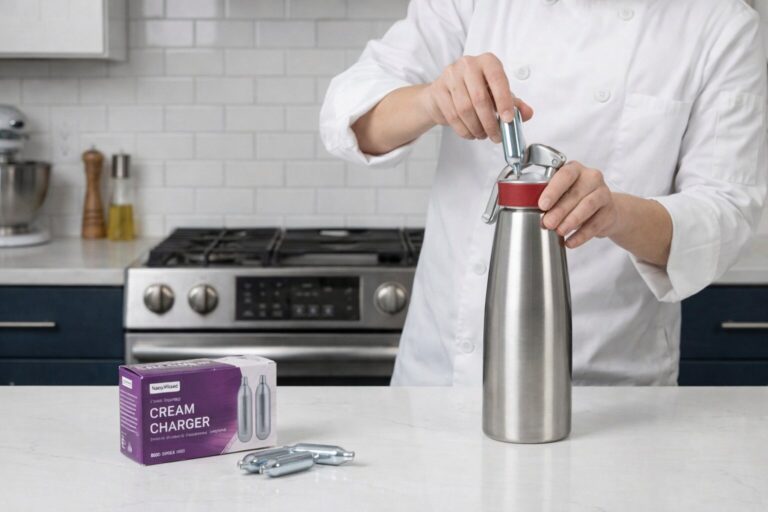




TLDR; Catering an event is a different job from daily café service. You’re whipping for a fixed guest count in a tight window, often off-site, so the planning is about volume and logistics. Work out your charger and cream needs from guests, courses and serves per head, add a buffer, keep everything cold in transit, and line up a supplier who can reach the venue fast.
Planning the use of cream chargers for caterers is chiefly a numbers game rather than just a catering thought. Before you think about flavour and range, you need to know how many serves you are producing and how much cream that takes. Armed with these basic figures, you can figure out how many chargers will see you through without being caught off-guard mid-service.
The difference from everyday service is the scale and the setting, though. While a café tops drinks one at a time across a regular shift, an event is an entirely different animal, with headcount, fixed menus, and a hard finish time in the equation, often in an unfamiliar venue kitchen you have never worked in.
That changes how you pack and run the gear. This guide covers how to do that, without leaving anything to chance.
Table of Contents
Key Takeaways
- Plan from guest count, number of courses and serves per guest, then add a buffer for busy events.
- One 8g charger whips roughly half a litre of cream; larger cylinders suit high-volume service.
- Keep cream and dispensers cold through transport and set-up, or the whip suffers.
- Carry backup chargers and a spare dispenser, and clean between batches to keep the texture clean.
- Check your state's nitrous oxide supply rules, since they vary and some restrict cylinders and delivery.
How to Plan Cream Chargers for Caterers
The maths are really quite simple. Just start with three numbers, including how many guests and cream courses, before considering the total number of serves each guest gets. Multiply them together and you have your total serves. Again, simple.
From there, the number of cream and charger counts are easy to arrive at, since a standard 8g charger whips around 500ml of cream, and 500ml of liquid cream yields roughly one litre whipped.
A real-world example probably makes it clearer: For 100 guests at a dessert service with one serve each, you need 100 serves. If a serve is about 60ml of whipped cream, that’s six litres whipped, so three litres of liquid cream and roughly six 8g chargers.
Here’s a simple planning table we prepared that applies to cream chargers for caterers:
| Guests | Serves per guest | Total serves | Liquid cream | 8g chargers |
|---|---|---|---|---|
| 50 | 1 | 50 | ~1.5 L | 3 |
| 100 | 1 | 100 | ~3 L | 6 |
| 150 | 2 | 300 | ~9 L | 18 |
| 250 | 2 | 500 | ~15 L | 30 |
You should probably take these as minimums, just to be safe. Obviously, a self-serve dessert station or a crowd going back for seconds tends to burn through cream much faster than a plated service.
ℹ️ PRO TIP: Build in a buffer of 15 to 20 percent on both cream and chargers for any event. Chargers can misfire, a dispenser can be dropped, and (as you are all too aware) guest numbers have a habit of creeping up on the actual day. The spare stock costs very little and may just save a service.
Choosing Equipment for Volume
For a small function, standard 8g chargers and a dispenser or two are plenty enough. Once you are serving hundreds of guests, feeding single-use chargers into dispensers all night becomes slow and wasteful, and larger systems start to pay off handsomely.
A larger cylinder connects to your dispenser through a regulator and hose, holding the equivalent of dozens of 8g chargers in one unit. For high-output catering, a bulk setup through a wholesale cream chargers supplier works out cheaper per serve, with far less fiddling around mid-service.
Your options (broadly speaking) split across three ways:
- Standard 8g chargers: ideal for smaller events, easy to transport, and simple to count out per batch.
- Larger cylinder systems: better value and far fewer swaps for big services, though they need a regulator and a little setup.
- Multiple dispensers in parallel: run two, three or more at once so service never stalls while one is being recharged or refilled.
For a sit-down dinner of 200-plus, most caterers using cream chargers run several dispensers side by side, so there is always one ready while another is topped up. Just match your dispenser count to how fast plates leave the pass, and you should be fine.
Cream Chargers for Caterers Working Off-Site
Off-site is where events tend to catch even the most experienced, highly organised team out. Using cream chargers for catering away from your own kitchen gets harder in a hired venue, a marquee, or even the back of a van, so plan the logistics as carefully as the menu in this instance.
The cold chain is the first thing to protect, because cream whips best cold, so it needs to stay chilled from your fridge through transport and set-up, and your dispensers should be cold too. Pack cream in insulated boxes with ice bricks, and chill the dispensers before you leave.
A few habits keep a remote service running cleanly:
- Carry backup stock. Spare chargers and at least one spare dispenser cover misfires and breakages.
- Clean between batches. Rinse the head, nozzle and gasket between cream changes so flavours and texture stay clean.
- Line up fast resupply. Have a supplier who can deliver whippers and dispensers and chargers to the venue at short notice if you run short.
Of course, none of this is particularly complicated, but it's usually the difference between a calm, well-delivered service and a panic driven scramble. Write a kit checklist and run it before every event to ensure everything goes smoothly.

ℹ️ DID YOU KNOW: A standard 8g cream charger whips roughly half a litre of cream, but a single 580g cylinder holds about the same gas as 80 standard chargers. For a large event, that’s one unit to pack and track instead of dozens of little steel bulbs.
Rules for Pressurised Gas and Supply
Cream chargers are relatively safe to use, but they do hold nitrous oxide under extreme pressure, so they need sensible handling. To that end, always store them cool and dry, keep them away from direct heat in a hot van or marquee, and don't puncture or incinerate spent units. Also, recycle empties through the right channels, since the steel is recyclable once fully discharged.
The supply rules are just as important, and they have tightened somewhat of late. Nitrous oxide is legal Australia-wide for culinary use, but several states now restrict how it's sold.
Check Local Rules & Regulations
At the time of writing, NSW rules that took effect in November 2026 limit late-night sales and same-day delivery, while Western Australia bans large cylinder nitrous oxide tanks over 10g for general sale and restricts purchases to registered food businesses. South Australia sets an 18-plus limit and bans late-night sales.
For caterers using cream chargers, the key point is that legitimate food-business use is recognised everywhere – but the details differ by state – so always confirm your local position and keep your business documentation handy when ordering.
Event Menu Ideas That Work at Scale
Whipped cream and foams go a long way at events, and cream chargers for caterers produce them fast and consistently from a dispenser. The trick is choosing formats that plate quickly and hold up on a buffet or pass.
A few that work well for volume service include:
- Dessert stations: self-serve or staffed, with freshly dispensed cream over pavlova, waffles, brownies or fruit.
- Hot drink toppings: a coffee or hot chocolate cart with piped cream is a reliable crowd-pleaser, especially for winter events.
- Mousse cups: pre-portioned in small glasses, topped to order, these look sharp and move quickly on a dessert table.
Either way, these formats share the same trait: the cream is always added fresh and close to serving. That is where cream chargers for caterers beat pre-whipped cream hands down, as pre-whipped tends to deflate and weep on a long, drawn-out buffet – a fate best avoided if you want repeat business and great reviews.
ℹ️ PRO TIP: At a staffed station, keep a charged dispenser in an esky or under-bench fridge and only bring it out to plate. Dispensing to order, rather than pre-topping a tray of cups that then sit on the pass, keeps every serve looking freshly made right to the last guest.
Bottom Line
In terms of cream chargers for caterers use, a well-run event simply needs the volume planned and the cream kept nice and cold, although a supplier who won’t leave you short on the day certainly helps, too. Those basics aside, just count your serves, pack a buffer, match 8g chargers or cylinders to the size of the job, and bring enough dispensers on the day.
Do that groundwork diligently, and the whipping becomes almost an afterthought. But remember, running low the week of a big booking is every caterer’s nightmare. Order NangWizard’s cream chargers in bulk, with cylinders and fast delivery straight to your venue, so you turn up with plenty of stock to spare.
Frequently Asked Questions
1. How many cream chargers do caterers need for an event?
Work it out from guest count, courses and serves per guest. As a rough guide, one 8g charger whips about 500ml of cream, so 100 single serves of around 60ml need roughly six chargers and three litres of cream. Add a 15 to 20 percent buffer for busy events.
2. Are cream chargers for catering better as 8g or cylinders?
It depends on scale. Standard 8g chargers suit smaller functions and are easy to transport, while larger cylinders are more cost-effective and need fewer swaps for big services. Many caterers keep both on hand.
3. How do you keep whipped cream stable at an off-site event?
Keep the cream and dispensers cold from transport through to service, and dispense fresh close to serving time. Freshly dispensed cream from a charged dispenser holds its shape far longer than pre-whipped cream on a buffet.
4. Is it legal for caterers to buy cream chargers in Australia?
Yes, cream chargers are legal for culinary use across Australia. Some states restrict consumer sales, delivery hours and cylinder sizes, but registered food businesses can buy for food preparation. Check your state’s current rules before ordering.
Rate this post

Nang Wizard
As the driving force behind Nang Wizard, I'm proud to lead Melbourne's fastest instant delivery company. With a team of 5 dedicated drivers strategically positioned across the city, we guarantee under one-hour delivery times. Our unwavering commitment to trustworthiness and customer satisfaction has earned us a 5.0-star Google Maps rating, and we're known for offering 100% refunds if a customer's delivery isn't on track within 15 minutes. With over 20,000 orders completed, we've become Melbourne's most trusted Kitchen Supply Store, ensuring our customers always come first. Join us and experience the magic of Nang Wizard.
Other Articles
Shopping cart0
There are no products in the cart!
Continue shopping