







TLDR: Cream chargers for mobile catering work best with compact 0.5L stainless dispensers and stock that packs into a small crate. Keep cream at 5°C or below, and store chargers in their original box below 50°C, away from your dispensers. Plan one 8g charger per 25 or so toppings, plus a 30 per cent buffer for busy days.
Whipped cream is on a large number of mobile menus, from waffles and cakes to hot chocolates and coffee. But making it in a food truck brings problems a shop kitchen never has to deal with. The fridge is small and the chargers have to travel with you, so choosing compact equipment and storing it properly makes a big difference to how smoothly a trading day goes.
This guide covers cream chargers for mobile catering, from food trucks and market stalls to pop-ups and coffee carts, where space and power are obviously quite tight. It’s not a comprehensive guide, but we do run through the main points you need to get right, from choosing compact equipment and keeping cream cold to storing chargers safely on the road and planning stock for market days.
Table of Contents
Key Takeaways
- A compact 0.5L stainless dispenser, plus one spare, suits most food trucks and market stalls.
- Cream needs to stay at 5°C or below all day, in a 12V fridge or a cooler packed with ice bricks.
- Chargers hold pressurised gas and must stay below 50°C, so never leave them in a parked vehicle on a hot day.
- Plan one 8g charger per 25 toppings and add a 30 per cent buffer for busy days.
👉 Catering large sit-down events? Our caterers’ buying guide shows how to plan charger stock by guest numbers.
How Mobile Businesses Use Whipped Cream
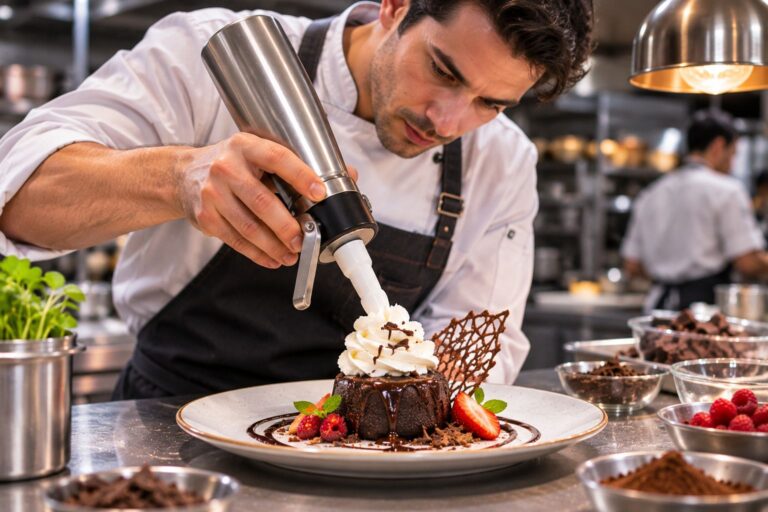
Mobile menus tend to be short and quick to serve, and whipped cream turns up on more of them than you might expect. A waffle van uses it on almost every order, while a coffee cart might only need it for hot chocolates and the odd iced drink. Either way, whipped cream is a key component of your typical mobile catering truck these days.
Let’s take a look at how much cream the most popular mobile menu items typically use per serve:
Menu item | Common on | Approx. cream per serve |
Waffles and pancakes | Dessert vans, market stalls | 40 to 50ml |
Hot chocolates and mochas | Coffee carts, winter markets | 20 to 30ml |
Iced coffees and cold foam drinks | Coffee carts, summer festivals | 20 to 40ml |
Dessert cups and sundaes | Dessert trucks, pop-ups | 30 to 40ml |
No matter what’s on your menu, using cream chargers for food trucks means you can top each order quickly and get roughly the same amount of cream on it every time, which keeps the queue moving on a busy day.
Choosing Equipment for a Small Space
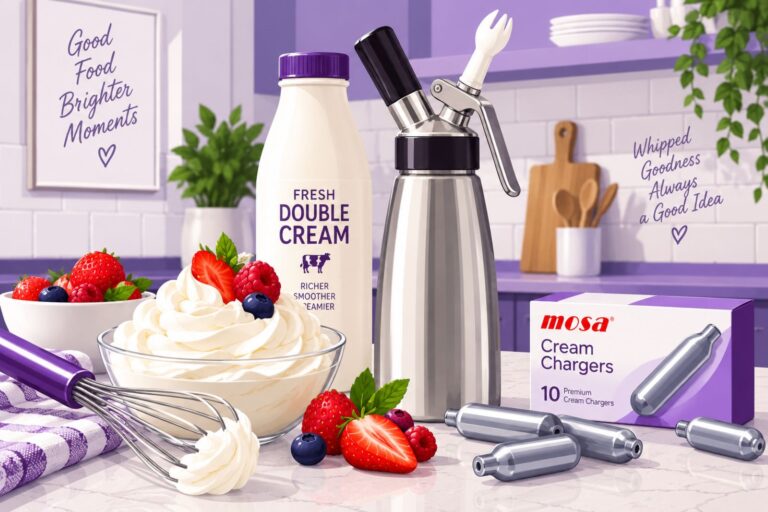
Bench space inside a food truck or coffee cart is usually limited to a metre or two, so your equipment needs to be compact and easy to stow. A 0.5L stainless steel dispenser suits most mobile setups, since it fits in a small fridge door or cooler and uses a single 8g charger per fill.
Carry a spare too, because a worn gasket mid-market can stop cream sales completely. You can compare sizes in our range of compact whipped cream dispensers, and pack a spare gasket and nozzle for each unit.
Also, when buying cream chargers for food trucks, always stick to one brand with the standard fitting so every charger suits both dispensers – many mobile caterers are caught out this way as not all fitments are universal, in terms of spare parts.

Keeping Cream Cold on the Road
Thickened cream needs to stay at 5°C or below from the shop to the customer, which is harder to manage when your fridge runs off a battery or a generator. A 12V compressor fridge is usually the most reliable option for food trucks, since it holds temperature all day without ice.
Stalls and pop-ups without power can get by with a hard-sided cooler, packed with ice bricks rather than loose ice so the dispensers stay dry. Check it every couple of hours and swap in fresh bricks as needed.
Remember, cream chargers for mobile catering only give good results when the cream stays nice and cold, so always return each dispenser to the cooler between orders.
Cleaning and Sanitising Without a Full Kitchen
Most mobile kitchens have a small sink and limited hot water, so a full strip-down on site isn’t always too practical. The simplest (and most common) approach is to carry enough clean dispensers and parts for the whole day, then do the full wash back at base.
On site, just rinse the nozzle with hot water between batches and keep used parts in a sealed tub. Simple. Back at base, release the pressure and strip the head, then wash every part in hot soapy water before sanitising and air-drying overnight, and if dried cream has set inside the tip, our guide to clearing a blocked nozzle is definitely worth a quick read.
Storing and Moving Chargers Safely
Every cream charger holds gas under pressure, and that pressure climbs with the temperature. Manufacturers generally say to keep chargers cool and dry and never above 50°C. The problem is, a closed vehicle in the height of the Australian summer sun can pass that figure quite easily.
For that reason, cream chargers for mobile catering should never be left in a parked van between events.
- Keep chargers in their original packaging, which protects them from knocks.
- Carry chargers apart from your dispensers, and never leave a charger screwed into a holder while driving.
- Pack the box low in the vehicle, away from engines, generators, grills and windows.
- Bring chargers inside overnight rather than leaving stock in the truck.
ℹ️ PRO TIP: On hot days, keep the charger box in an insulated bag in the shade, away from the fryer and coffee machine, and only take out what you need for the next refill.
Stock Planning for Events and Market Days
Stock for cream chargers for mobile catering is easiest to plan from the serves you expect to sell, rather than a fixed weekly order. One 8g charger whips a 0.5L fill, which gives about 25 standard toppings:
Chargers for the day = expected cream serves ÷ 25 × 1.3
The extra 30 per cent covers a busier-than-expected crowd and the odd charger lost to a re-charge.
Event | Expected cream serves | Chargers to pack | Cream to pack |
Weekday market | 80 | 5 | 2.5L |
Weekend market | 200 | 11 | 5.5L |
Festival or sporting event | 500 | 26 | 13L |
Restocking Away From Base
Multi-day festivals and regional trips are where cream chargers for food trucks most often run short, because the nearest supplier may be hours away. So, try to order at least a week ahead for big events, with delivery to a depot near the event or straight to the venue, and check first that someone aged 18 or over can receive the delivery.
Age, Supply and Food-Safety Rules
Cream chargers are legal for culinary use across Australia, but sale rules vary by state. As of November 2026, NSW and South Australia bar sales to under-18s and between 10pm and 5am, while Western Australia supplies only approved recipients. Our guide to nang laws in Australia covers each state in detail.
Mobile food businesses must also be registered with their council, and in Victoria that means registering through FoodTrader and lodging a statement of trade before each event. Rules on cold storage and hand-washing differ between areas, so confirm the requirements with your council and each event organiser.

Bottom Line
A mobile setup works best when everything on board stays compact and cold. Run small dispensers with a spare, keep cream at 5°C or below, store chargers cool and boxed, and plan stock around each event rather than ordering blind.
When you’re ready to stock the van, you can buy cream chargers with fast delivery across Melbourne and shipping Australia-wide.
FAQs About Cream Chargers for Mobile Catering
1. What size dispenser suits a food truck?
A 0.5L stainless steel dispenser suits most food trucks and coffee carts, as it fits in a small fridge or cooler and takes one charger per fill.
2. How do you store cream chargers for food trucks?
Keep cream chargers for food trucks in their original box, somewhere cool and dry below 50°C, and apart from your dispensers. Bring them inside overnight.
3. Can you leave cream chargers in a hot car?
A closed vehicle in summer sun can climb past the 50°C limit most manufacturers set, so it’s best avoided. Carry chargers in an insulated bag and take them with you when you park.
4. How many cream chargers for mobile catering do I need for a market day?
Divide your expected cream serves by 25 and add 30 per cent. A weekend market with around 200 cream-topped serves needs about 11 chargers.
5. Do mobile food businesses need registration to buy cream chargers?
Your business needs council registration to trade, and buying cream chargers for mobile catering may also require ID, business details or, in Western Australia, approved recipient status. Check the current rules with your council and supplier.
Rate this post

Nang Wizard
As the driving force behind Nang Wizard, I'm proud to lead Melbourne's fastest instant delivery company. With a team of 5 dedicated drivers strategically positioned across the city, we guarantee under one-hour delivery times. Our unwavering commitment to trustworthiness and customer satisfaction has earned us a 5.0-star Google Maps rating, and we're known for offering 100% refunds if a customer's delivery isn't on track within 15 minutes. With over 20,000 orders completed, we've become Melbourne's most trusted Kitchen Supply Store, ensuring our customers always come first. Join us and experience the magic of Nang Wizard.
Other Articles
Shopping cart0
There are no products in the cart!
Continue shopping